econogineer

Monday, August 21, 2006

A Challenge to the Law


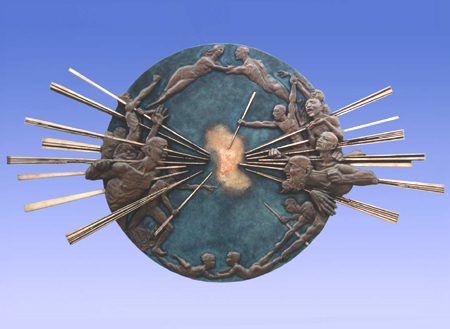
An Irish company has recently placed an advertisement in the Economist challenging the scientific community to disprove their perpetual energy machine. Even their press releases cause a stir. Is this company for real?

A goal of this blog is to bring an understanding of energy flow in ecosystems into the realm of economic study. Though this seems like a perfect subject, this econogineer is very skeptical. Many have called it a scam, but it could be a misunderstanding or misinterpretation of the results. Many years ago, I was paid by an investor to look at a perpetual energy machine in Rome, Georgia. This company had also issued challenges and only very slim details. I visited them and got a stack of information. They also told me a Civil Engineering professor at Georgia Tech could find no problem with their assertion that they could produce steam with less energy than the latent heat of vaporization (ie, the energy required to turn water from a liquid state to a gaseous, higher energy state). Their process involved the commonly known phenomenon of cavitation. They literally had money pouring in. However, one look at their apparatus in person revealed the flaw in their logic. They did not account for quality. They were using tap water at 60 psi and producing steam at atmospheric pressure. It takes energy to deliver water at 60 psi; that's part of what you pay in your water bill.

Energy is such a generic word without substantive meaning. It needs qualifiers to be properly compared to other forms. Those qualities are time, space, and power. When and how fast does it produce? Where is it? How does it relate to other forms of energy, that is, what is the transformation to useful forms of energy like electricity.

A joule of sunlight and a joule of electric current have the same amount of energy, yet the electricity is certainly worth more in economic terms. Sunlight is dispersed, electricity can be concentrated in a wire. I can do a lot more with electricity than I can sunlight. One can be transformed into the other, that is, I can turn on a bright light with electrcity or use a solar panel to generate electricity. Each of theses processes will result in losses, i.e., less than one joule. Thus, according to the first two laws of thermodynamics, we cannot return to our original state. There is no such thing as a perpetual energy machine. Steorn refutes the second law. That they ascribe the second law to Sir Isaac Newton (who was responsible for the laws of motion) does not bode well for their thouroughness.

Like the steam engine above, Steorn may have a useful process that converts energy at one form to a more useful form. In our economy, we need all kinds of energy, from sunlight ( a very low quality energy) to human thought ( the highest form of energy). Whatever Steorn has, it will not change the basic dynamics of man's economy. We will still need materials to make things and we will still need all different types of energy and the processes that produce them. They may indeed have a process that will greatly impact the efficiency of many facets of our economy. One of the greatest processes to do just that is the one you are using now, the Internet. It facilitates the movement of knowledge from one person to the next. It has been the greatest impact to our economy since the gasoline engine.

I seem to recall it coming upon us with less mysteriousness.

Sunday, August 13, 2006

The Trade Deficits are Falling!


Okay. So it isn't really big news, especially compared to other recent events. Moreover, the Trade Deficit didn't just fall, it improved!

Not exactly earth shattering stuff, but the trade deficit is typically a hot button issue when the elections roll around. Like the Federal Reserve Funds Rate, not many people really understand exactly what it means. The better term is Current Account Balance. This number tells us who owes who money after exports and imports are tallied up. Currently, the US holds a very large imbalance of payments with China and pretty much the rest of the world. Logistically, this is only an accounting term because, in actuality, China and the rest of the world have been paid, they've just chosen to deposit the money in a US bank rather than exchange it for their currency or buy US goods. The trade deficit, therefore, is not a debt. As Milton Friedman has pointed out, if you include banking services (as an econogineer would argue since goods and services are only different forms of labor), there is no such thing as a trade deficit. Our import partners have merely chosen to purchase interest bearing bank accounts. This shouldn't strike anyone as odd since we offer very good and honest banking services, something not present in many foreign markets. If you had a business in Russia, where would you want your money? In a Russian bank under the greedy eyes of the Kremlin or the US? We offer lots of financial services and security for which we charge a premimum.

Still, the Trade Deficit raises much consternation from many circles, especially those with a protectionist agenda. Accusations of "dumping" are routine when some manufacturing sector feels it is subject to unfair trade practices. This, however, cannot be argued to be beneficial for the entire United States. In fact, what benefit has the US gained by protecting the car industry? It saved jobs for people in that industry at the cost of everyone having to pay many thousands more for their cars. In politics, it's concentrate the gain, spread the pain (but the total pain is almost always more than the total gain).

This has led some to propose absurd arguments to support their negative opinions about the Trade Deficit being the ruin of us all. In this story, the author proposes that there is a correlation between US debt and the Trade Deficit when it is obvious his graph shows the opposite. What's more interesting is that from my own analysis using Bureau of Economic Analysis data, it's easy to show that growth in Gross Domestic Product has a higher correlation with Imports (correlation coefficent of 0.77) than with exports (coeff. of 0.33). In fact, during periods of expansion, that correlation increases for imports and decreases for exports! This shouldn't surprise anyone because when we are expanding, we're even more attractive for investment. All that money lowers our lending rates through supply and demand. Who cares who you pay the interest if that interest is lower? Even with an unusally weak dollar, the Chinese and many others still would rather keep their money here. Mortgage rates are lower now than back in the early 90s when the trade deficit growth was zero. Or how about in the 70s when we had a trade surplus but mortgage rates were over 15%?

Most importantly, we need to remember that the trade deficit is expressed in dollars. In terms of physical goods, we hold a surplus. Although the new Ben Franklins are pretty, I'd much rather look at an HDTV.

Strategically, we should also be happy to hold large balances of the world's money. It makes them less likely to do something to cause us to confiscate those billions. They are, in the world of international politics, bargaining chips.

In the end, we all win though I think the Chinese people in a free system might want to enjoy a better standard of living instead of helping us improve ours. This is the major negative. The econogineer hates government manipulated markets and exchange rates. The Chinese fix their exchange rate artifically low to encourage export. We are certainly making out in this deal but it's creating a false sense of luxury in us at the expense of the Chinese people and perhaps our own and other foreign manufacturers. On the whole, though, we benefit greatly from this exchange.

Thursday, August 10, 2006

Feds Freeze Funds Rate

Say that 10 times in a row. Not easy, huh? Neither is understanding exactly what it means when the Federal Reserve adjusts the Funds Rate, as they have just failed to do for the first time in two years. I know a lot of people who keep up with this but very few can really explain the inner workings of the Federal Reserve and the Funds Rate. How does the Funds Rate affect our economy? Where does it affect it? Who does it affect?

The Fed Funds Rate is a high frequency signal that is beamed out from secret installations to miniature receivers implanted in our brains by complicit pediatricians impelling us to consume to support the military-industrial complex.

That, of course, would be Oliver Stone's screen interpretation of the Fed but it's not that far off the mark albeit with less sinister overtones. In actuality, most of the US money supply exists outside of the control of the Federal Reserve. Thus, they rely heavily on the power of suggestion. Mostly, they operate in secret (though they are, sadly for you conspiracy theorists, subject to public disclosure laws that purely private institutions aren't). They do make a point of publicizing Federal Funds Rate moves because they wish to signal to the general public a loosening or tightening of the money supply. Bankers, stock brokers, mortgage brokers, purchasing agents, etc are supposed to get the message and act accordingly. The Fed does have a level of enforcement. The Funds Rate itself is the rate that banks (who are members of the Federal Reserve System) lend to each other. Actually, the Funds Rate is a target. The Federal Reserve achieves this target by what they call open market operations (the buying and selling of US treasury securities). Generally, banks go along with the rate increases and adjust the prime rate, or the interest rate charged to preferred customers. All other interest rates are generally pegged off it. Your equity line or credit card is sometimes listed as Prime + points.

You'll notice that I use a lot of evasive verbiage when talking about the Fed. Truly, there are so many other forces in the market that it's never clear what effects the Funds Rate actually has. Government fiscal policy, i.e., taxing and spending, has a much larger effect. I always explain the function of the Federal Reserve as being analogous to the fireman who steers the rear trailer of a ladder fire truck. Their job is to make the ride smoother, which they do with various rates of success. They were formed in 1913 to prevent the cyclical market panics that seemed to plague the economy. Shortly after in October of 1929, as if to prove the Robert Burn's line of the best laid plans of mice and men, the economy crashed like it has never crashed before.

For the econogineer, the most important aspect that we should understand, is that the engine of our economy is very large and powerful. It's inertia, that is, the resistance to the change in motion, is enormous. It's important to understand that changes are reflected only very slowly.
Actually, the recent rate moves by the Fed resembles the dynamic control variable response of a self-tuning controller system to a disturbance . And you thought the Fed was fuzzy. Suffice to say that this gives me hope that the Fed understands what is going on. The Funds Rate, assuming we don't have any more large disturbances like 9/11, should follow a first order oscillating decay, shown to the left (although the Fed Rate curve is the inverse of this, meaning we've just gone through the first trough).

Wikipedia, of course, has a good explanation of the Federal Funds Rate.

A good read for masochists is Greider's Secrets of the Temple. It's 800 pages and details mostly Volker's chairmanship during the late 70s, early 80s. Another good one, only slightly less masochistic, is the 700 page Creature from Jekyll Island, referring to the location of the 1913 meeting that created the Fed. Most people who have an informed opinion about the Fed tend to have extreme views; they either love it or hate it. In my opinion, the Fed serves a necessary function in an economy ruled with fiat money (cash not based on some real commodity). However, we should remember that they are a private institution that looks out for the overall health of their members, which are other banks.

Friday, August 04, 2006

California Dreaming


California made the news by agreeing to a climate emissions treaty with Great Britain. This is being touted in Europe and among environmenatlists as a big step toward fighting global warming.

On the face, it appears that this treaty and Kyoto are allowing market forces to curtail greenhouse gases. However, the incentive side of this exchange is created artificially through caps or "goals". From a classical economics point of view, the econogineer dislikes caps but that's not the biggest problem with the emission exchange treaties.

California is indeed a large producer of greenhouse gases but they are also one of the largest producers of "green" technology and they are, for most parts, a highly efficient economy. The amount of production per pollution is much higher than most places in the world (Japan being one of the highest). By outsourcing or selling production to places where the treaties do not restrict greenhouse emissions, we could easily be making the problem worse. What of the pollution produced from the extra transportation? If Global Warming is a Global Problem, why not have a Global Treaty? A treaty that covers all countries and seeks to limit total emissions?

Having read the Kyoto Treaty, page by page, it seems the powers that be said to themselves, "let's do something, even if it makes no sense, and while we're at it, we'll get the US to send more money to the third world". Why does Russia get to have inordinately high emission level because we've chosen as a basis a period in time when the former(?) communist state was spewing inordinate amounts of pollution? Because Russia wouldn't agree to it any other way. This way they get paid off without having to actually help. They're not the only ones to get the pay off without helping the bottom line.

Even California is disingenuous in its participation. Their manufacturing sector has been heading south to Mexico for a long time. As we all know, California has been outsourcing its energy production to other states because they want to be greener. With losses due to transmission of electricity, it's pretty clear that the world will have more pollution but it just won't be in California. It will be dispersed to Texas, Utah, Nevada, etc.

It's all Smoke and Mirrors.

Wednesday, August 02, 2006

An Inevitable Truth


Reason.com's Shikha Dalmia has written a good article on the hybrid myth based on a 500 page report from CNW Marketing Research. The government pushes these not because they are a solution but because they appear to be a solution. Same with wind and solar energy and many other "alternative" sources.

I don't deny that we have problems with pollution and energy. I just take issue with processes which could cause more problems...all for the sake of helping us sleep better at night with the AC on full. Many of these solutions actually absorb more energy and produce more pollution (albeit indirectly) than the bad technology they are proposed to replace.

With respect to the latest article, here are the common misconceptions of the public, as I see it:
  • oil (and by derivative, gasoline) are the only things that produce polution
  • money spent on gasoline goes only to gasoline
  • money spent on the car purchase does not generate oil usage

According to the basic principles of economics engineering, all processes are connected. People should view the dollar transaction as generating a specific amount of polution and absorbing a specific amount of energy. While not accurate for buying a painted rock at a craft fair, it is a useful concept on the whole. They should stop thinking of gasoline as the only usage of fossil fuels they are causing. The manufacture of the vehicle typically accounts for more energy usage and environmental impact than the actual fuel it will absorb over its lifetime.

Global Madness

In politics, perception is the rule but in science, it is dangerous. The government sometimes pushes solutions that are nothing of the sort in order to satiate a public all too sure that solutions hang like apples from trees. One only needs the will to pick them.

In a talk I once gave on the problems with renewable energy technology, a woman became so frustrated that she said that the government was purposefully denying technology from the public in order to help the oil companies. It's an all too common complaint, even in our educated society. What was most troubling was that this person was a trained scientist.

The idea is very simple. The luxury that we enjoy depends on high yield energy sources. With oil and coal, you can get 4 times as much energy as you put into it. That's a 400% yield. That affords us a lot of extra energy to spend it on items we need but do not produce energy, e. g., home electronics, nice clothes, fast cars, air conditioning. Going to something less than petroleum based sources as a basis for your national energy usage, means, necessarily, a contraction in living standard.

Actually, the quality of oil in terms of overall yield has been steadily going down since the late 60s. However, our effieciency has increased dramatically, masking the decrease. We've gotten better in not only deriving energy from fossil fuels but in all processes in our society. We saw an explosion in wealth in the 90s not due to more oil being found but to the impact of cell phones and the internet.

Oil will not run out suddenly, it will slowly get more rare and more expensive and we will either keep finding new efficiencies or we will have to contract our living standard.

My former teacher in this subject has written a good book called "The Prosperous Way Down". A bit academic but accessible.